Showing posts with label Travel. Show all posts

Monday, 17 April 2017

Travel Ideas Number 01: The Anabasis To Corinth Of Kudakwashe Kanhutu

I have not yet made this trip but when I do, it will involve two big ideas as templates; 1. visiting all the places it is said Apostle Paul visited after the Ascension and, 2. tracing all the places where the major battles of the Peloponnesian War took place as recounted in The History of the Peloponnesian War by the Athenian General - Thucydides. This kind of trip will involve a lot of Island hopping by ferry - something I have already done - but I will also need a vehicle so as to drive from point A to B at my leisure.
 
To psyche myself for my expeditions, I normally like to quote military passages as they tend to focus on the essence of the matter. But not this time around, this time around my inspiration for the trip will come not from Thucydides’ The History of the Peloponnesian War - the greatest book of all time - instead, it will come from Apostle Paul’s message to the Corinthians in 1 Corinthians 13, he said:

“Love is patient, love is kind. It does not envy, it does not boast, it is not proud. It does not dishonour others, it is not self-seeking, it is not easily angered, it keeps no record of wrongs. Love does not delight in evil but rejoices with the truth. It always protects, always trusts, always hopes, always perseveres” - Apostle Paul, Epistle To The Corinthians.

Island hopping by Ferry in Greece (2012)
1 Corinthians 13 

If I speak in the tongues of men or of angels, but do not have love, I am only a resounding gong or a clanging cymbal. If I have the gift of prophecy and can fathom all mysteries and all knowledge, and if I have a faith that can move mountains, but do not have love, I am nothing. If I give all I possess to the poor and give over my body to hardship that I may boast, but do not have love, I gain nothing.

Love is patient, love is kind. It does not envy, it does not boast, it is not proud. It does not dishonour others, it is not self-seeking, it is not easily angered, it keeps no record of wrongs. Love does not delight in evil but rejoices with the truth. It always protects, always trusts, always hopes, always perseveres.

Love never fails. But where there are prophecies, they will cease; where there are tongues, they will be stilled; where there is knowledge, it will pass away. For we know in part and we prophesy in part, but when completeness comes, what is in part disappears. When I was a child, I talked like a child, I thought like a child, I reasoned like a child. When I became a man, I put the ways of childhood behind me. For now we see only a reflection as in a mirror; then we shall see face to face. Now I know in part; then I shall know fully, even as I am fully known.

And now these three remain: faith, hope and love. But the greatest of these is love.

Piraeus Port, Athens (2012)

Boarding The Flying Dolphin at Piraeus, Athens for my first Greek Anabasis (2012)

Thursday, 27 October 2016

What Lessons From The United States For Our Discerning Person?

It would be interesting to tour a few select successful companies in the United States in 2017, and study them scientifically in the process. Asking oneself; “what has made them this successful, is it something in the water?” Quite naturally, of course, the Boeing Company in Seattle would be the first stop.

Executive Biography of William E. Boeing

William E. Boeing. Boeing Airplane Company, Founder and Owner, President and Chairman of the Board.

William E. Boeing left Yale University in 1903 to take advantage of opportunities in the risky and cyclical, but financially rewarding, Northwest timber industry. That experience would serve him well in aviation.

The Boeing 777 - 300 Extended Range.

Under his guidance, a tiny airplane manufacturing company grew into a huge corporation of related industries. When post-Depression legislation in 1934 mandated the dispersion of the corporation, Boeing sold his interests in the Boeing Airplane Co., but continued to work on other business ventures.

Boeing 777 Interior.

He became one of America's most successful breeders of thoroughbred horses. He never lost his interest in aviation, and during World War II he volunteered as a consultant to the company. He lived until 1956, long enough to see the company he started enter the jet age.

Boeing 777 Interior 2.

William E. Boeing was a private person, a visionary, a perfectionist, and a stickler for the facts. The wall of his outer office bore a placard that read: "2329 Hippocrates said: 1. There is no authority except facts. 2. Facts are obtained by accurate observation. 3. Deductions are to be made only from facts. 4. Experience has proved the truth of these rules."

Boeing 777 300ER

According to his son, William Boeing, Jr., Boeing was a fast and avid reader and remembered everything he read. He was also a perfectionist. While visiting his airplane building shop at the Duwamish shipyard in 1916, Boeing saw a set of improperly sawed spruce ribs. He brushed them to the floor and walked all over them until they were broken. A frayed aileron cable caused him to remark, "I, for one, will close up shop rather than send out work of this kind."

Boeing 777 - 300ER

Monday, 17 October 2016

Russia Visit: A Preliminary Post-Mortem

"All travel has its advantages. If the passenger visits better countries, he may learn to improve his own. And if fortune carries him to worse, he may learn to enjoy it" - Dr Samuel Johnson.

Russia!
by Kudakwashe Kanhutu

This is the stuff dreams are made of! My Russia visit had that magical quality one only finds in memories from childhood journeys. I have not been excited about anything - and I mean ANYTHING - for a long time, but boarding the Aeroflot Airbus A330, and sweeping into the night sky over London to head to Moscow, felt like a reward for a lifetime of efforts. And, being in Russia itself was even more reward as the whole country is a large answer book to all the philosophical, political, historical, military and international relations questions that I have wrestled with over the past 10 years. 

It will take me all of November to write everything of note with regards the trip to Russia, by which time I will probably have gone back again because I loved being in Russia. I have provisionally broken down what I will write about Russia into these four manageable sections: The People, Political History, Economic History, and Military Doctrine. These will be treatise length entries, and I make no apologies for their lengths, as subjects this important deserve such attention. These four categories are also not mutually exclusive, because the Russian psyche does not make such a distinction. Imagine if in “The People,” I choose to discuss Lenin as a historical figure of note, already in discussing him I will be touching on “Political History,” “Economic History,” and “Military Doctrine” because he wrote the book on Russia’s path in all these spheres from 1905 to present day. For Economic History, I will use my visit to the Stalingrad Tractor Plant as a case study for how communism and capitalism have been received in Russia. There are some interesting characters from Russia, one would never hear of if one does not go to Russia: Marshal Georgy Konstantinovich Zhukov is one such character. That his brilliance is not generally acknowledged in the West, while there are monuments and paintings of him on every street corner in Russia, means I will make a separate entry for him. 

My task is simple really; write all I did to visit a certain place, the things I saw and enjoyed, and the life lessons I learnt so that my reader, if he or she feels so inclined, will make the same trip and improve upon it, and in the process improve themselves. You cannot cross a time zone and fail to learn something new that will improve you.

All the technological achievements under Communism is a subject I will talk about at length.

The Motherland Calls Monument, Volgograd.

The Moscow Metro itself has museum-worthy works of art and statues.

Marshal Georgy Konstantinovich Zhukov. Adolf Hitler once said about him: "If I had one general like Zhukov, I would have achieved world domination by now."

Saturday, 7 May 2016

My Sisyphean Ordeal

“To two men living the same number of years, the world always provides the same sum of experiences. It is up to us to be conscious of them” – Albert Camus.


by Kudakwashe Kanhutu

In which I relate the exact nature of my fear that the next person may know more than me. 

The word Sisyphean refers to any interminable labour where success is never attained. Life – insofar as it always tends to end in death – is Sisyphean, but we are not going to get that philosophical in our discussion today. The Greek myth of Sisyphus holds that King Sisyphus of Corinth was punished by the gods “for his self-aggrandizing craftiness and deceitfulness by being forced to roll an immense boulder up a hill, only to watch it roll back down, repeating this action for eternity.” King Sisyphus’s deceitfulness had even begun to affect those he had never met. For example, when he was sentenced by the gods to detention in the underworld by Thanatos – the messenger of death – he tricked and chained Thanatos instead. With the messenger of death so indisposed, the result on earth was that no one would die and, with no one dying when struck, wars became difficult to win. A hue and cry was raised, and Zeus devised what can be, correctly, termed poetic justice:  “as a punishment for his trickery, King Sisyphus was made to endlessly roll a huge boulder up a steep hill. The maddening nature of the punishment was reserved for King Sisyphus due to his hubristic belief that his cleverness surpassed that of Zeus himself. Zeus accordingly displayed his own cleverness by enchanting the boulder into rolling away from King Sisyphus before he reached the top which ended up consigning Sisyphus to an eternity of useless efforts and unending frustration. Thus it came to pass that pointless or interminable activities are sometimes described as Sisyphean.” 

I have found this to be the exact nature of any determined quest for knowledge – any determined quest for anything! Forget not that just last week when I finished reading Miguel de Cervantes’s masterpiece – Don Quixote: The Ingenious Gentleman of La Mancha – I proudly announced that I had finished my quest to read all of the world’s classic works of note. Yet despite this announcement, I have just picked up Dante Alighieri’s The Divine Comedy, this, as a consequence of having recently visited Italy. But herein lies the rub, you can’t read The Divine Comedy without having first read Virgil’s The Aeneid, so I have had to put Dante aside and have to read Virgil’s Epic Poem instead. Can you picture my boulder rolling down before it reaches the top? 

My calling demands that I be conversant with all these classic works as the people I debate with, have a tendency of mentioning them in passing to illustrate a point in the debate. I was at a nuclear deterrence discussion once, when someone casually remarked that, “we run the risk, like Don Quixote, of mistaking windmills for giants, to ever be engaged with in mortal combat.” I didn’t know who the hell Don Quixote was or why he would mistake windmills for giants. I do now. I had also had to read some of these works for my Classics degree, but as will become evident below, reading to understand a work and reading to pass an exam are ever so different. A further point is that one of my hobbies is travel and, I have made reading the best classic works to come out of each country I am about to visit, part of my preparations for the visit. The more countries I visit, the more I am forced to read even more classic works. So, all these streams have met where I stand and conspired to make my quest for knowledge quite the Sisyphean ordeal. 

What you see before you now, is me having to read two more classic works in quick succession, this time from Italy. I visited Rome recently and beheld the Tiber River, walked along its banks and dipped my hand in its cool waters. This river has been a witness to history and has been invoked by poets and singers since time immemorial. It even has a nickname, they call it Flavus (The Blond). Standing before this river made me realise that I didn't know anything about this epic river. It made me remember that I had only given Virgil’s The Aeneid a very cursory read, you see, Virgil does mention and praises the Tiber River throughout his Epic Poem. I just did not know what importance the people of this land had attached to the Tiber River through the ages. 

When I read The Aeneid for my Classics exams, I only read enough to be able to build a case that Virgil’s Epic Poem closely follows the conventions set by Homer in The Iliad and The Odyssey. Such a reading does not require you to understand the story, it only needs you to pick up a few cues. Here, I will not bore you much with the details of literary study’s terms and conventions. There is something called intertextuality, whereby authors borrow from each other in telling their stories. This intertextuality is also the reason why I find myself having to properly read Virgil’s The Aeneid before I can proceed to Dante’s The Divine Comedy. My attempt to ignore The Aeneid and just read The Divine Comedy utterly failed when I opened the first page of The Divine Comedy. In the first Canto, Dante meets Virgil – and is full of praise for him – as Virgil, who died before him, becomes his guide in the underworld. There are so many references to Virgil by Dante in the first few pages that it became futile for me to try to understand The Divine Comedy without having read The Aeneid first.  

Now, I am going to Russia very soon, who knows the number of classic works from that part of the world I will be forced to read by my fear that the next person there may know more than me? In addition to all that, I must keep abreast with permutations in the contemporary world of war and diplomacy.


Sunday, 21 February 2016

My Greatest Disappointment In Barcelona

“By a small sample we may judge of the whole piece” – Miguel de Cervantes, Don Quixote: The Ingenious Gentleman of La Mancha.

The picture I really, really wanted to take in Montserrat!
It has come to my attention that most people lead busy lives, so do not have the time to read long treatises on trivial matters. In deference to that logic, my 4 blog entries for my recent trip to Barcelona (February 2016) will be 2 short paragraphs length and I will, each time, just touch on one aspect of the trip as; “by a small sample we may judge of the whole piece.” My photo essay, and its captions, at the end of the 2 paragraphs will then furnish the other details of the trip. 

by Kudakwashe Kanhutu, Montserrat, Catalunya, Spain 12. 02. 2016. 

I am a person who is more at home with nature than in the city. I am happier climbing mountains and navigating thick forests by following rivers than commuting on the express train between Terminal One and the Central Station (God knows there is both in every city). So, I was not as enthusiastic about visiting Barcelona as I should have been in all the 2 years I have been planning to go there. Even when I had paid for everything associated with the trip, I was still thinking it would be exactly like being in London (all big cities being a carbon copy of each other anyway). It was the most fortuitous thing that, with a week to go before departure, I came across the picture (above) of Montserrat on Facebook and, the owner of the picture had given helpful hints on how to get to Montserrat (including how much it costs). Thus Barcelona has something London does not have: the great outdoors!

The monument to Ramon Llull high in the Montserrat Mountains. The eight stages of the monument, in the form of a spiral, represent the eight stages of awareness: (stone, flame, plant, animal, man, heaven, angel, God) but when I got there it was fenced off. Sad day indeed.

Montserrat means “Saw Mountain” and the Caribbean Island of Montserrat was named after this mountain. It has many attractions, chiefly, the Basilica there which houses the Black Madonna (a site of pilgrimage for many). And, as this is Spain’s First National Park, nature hikes at this high altitude is also the other main draw. But even though these attractions were available to me, I am a one track minded person and what I really wanted to do in Montserrat was to take a picture exactly like the one above; balancing at the top of the monument to Ramon Lull. But this was not to be. You see, they have since fenced off this monument, perhaps because there have been fatalities among tourists attempting that pose. Each of the 8 blocks of this monument, as noted in the above caption, represents the levels of awareness starting with stone and going on through the levels to God at the highest. What made my not being able to take the above photograph a great disappointment is that when I got back to England, I saw a picture where someone had jumped the fence and taken the same picture anyway? Am I losing my sense of rebellion?? 

Facts and Figures: 

When you get to Barcelona, turn left and head for the mountains!


Montserrat, Catalunya.

Montserrat is 1 hour away from Barcelona by train which leaves from Placa Espanya every hour. The return ticket for this trip which also covers your Cable Car and Furnicular rides to the top of the Mountain costs €29.50 and can be cheaper if bought online in advance. Mine cost me €19.50: http://bcnshop.barcelonaturisme.com/shopv3/en/product/616/trans-montserrat.html


The cards I swear by in Barcelona - The TransMontserrat and the 5 Day Barcelona Pass.


Photo Essay:


Platform 4 at Placa Espanya is where you catch the R5 to Manresa. From Barcelona to Montserrat takes 1 Hour on the R5.

Placa Espanya, for the R5 to Manresa.

Platform 4 at Placa Espanya. The first train is at 08:36 and then every hour thereafter.
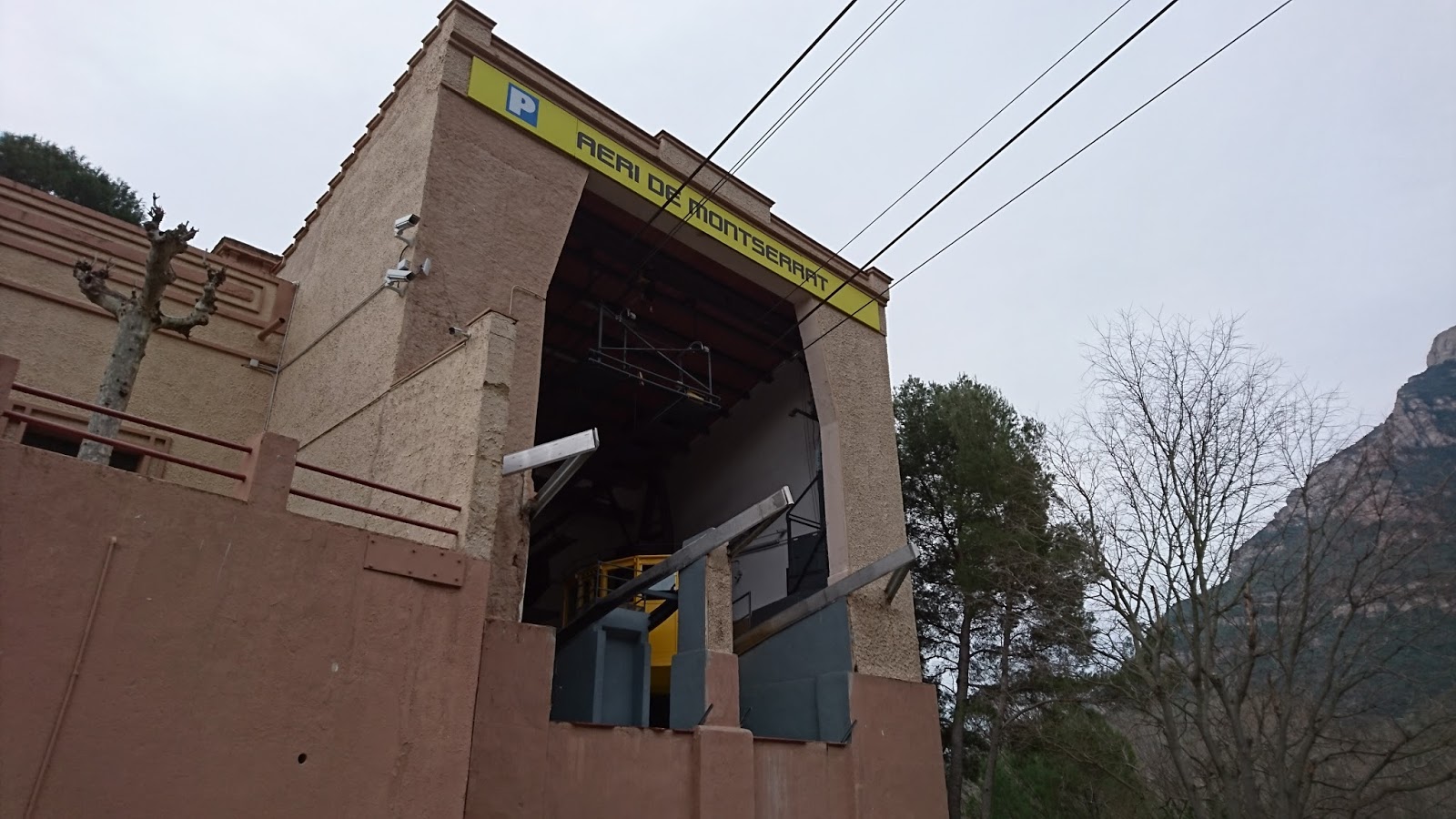
The R5 to Manresa  pulls in at the Aeri de Montserrat Station.

Aeri de Montserrat Station


My first sight of Montserrat


Montserrat, the part that overlooks the Aeri de Montserrat Station. The Rack Railway Station is the next stop (I think).
So happy to be here, before I found out I was not going to be able to execute my Coup d'main

The Cable Car Station

The Cable Car to halfway up the mountain.

The Cable Car in action

The view from the Cable Car on the way up

The Cable Car on the way up. Is that Burberry I spy high up in  the mountains like this?!

The view from the Cable Car on the way up.

Arrival on the other side.

Aeri de Montserrat Station. Mountain.

Looking around soon after disembarking from the Cable Car. 

Then disaster struck!

The other way to get up the mountain is this - the Rack Railway - but when you buy your TransMontserrat ticket you have to choose either the Cable Car or Rack Railway in advance. I chose the Cable Car.

The other way to get up the mountain is this - the Rack Railway - but when you buy your TransMontserrat ticket you have to choose either the Cable Car or Rack Railway in advance. I chose the Cable Car.

The views from up here, and this is only halfway up the mountain. I still had a climb to the summit ahead of me.


The object of my desire: to stand on top of this monument and have my picture taken.

The closest I got to climbing to the top of this monument. You can clearly see the different levels of awareness written on that monument with Deu (God) being on the highest block.

How I would have posed had I managed to climb to the top of the Ramon Llull monument.

How I would have posed had I managed to climb to the top of the Ramon Llull monument.

I believe this is a monument to the Spanish Civil War 1936 - 39.

I did not get to find out what this monument represents.

I did not get to find out what this monument represents.

But do not be disheartened by failing to make that dangerous pose on top of the Ramon Llull monument. The star attraction of Montserrat is this Basilica which houses the Black Madonna, one of Catalunya's Patron Saints.

But do not be disheartened by failing to make that dangerous pose on top of the Ramon Llull monument. The star attraction of Montserrat is this Basilica which houses the Black Madonna, one of Catalunya's Patron Saints.

But do not be disheartened by failing to make that dangerous pose on top of the Ramon Llull monument. The star attraction of Montserrat is this Basilica which houses the Black Madonna, one of Catalunya's Patron Saints.

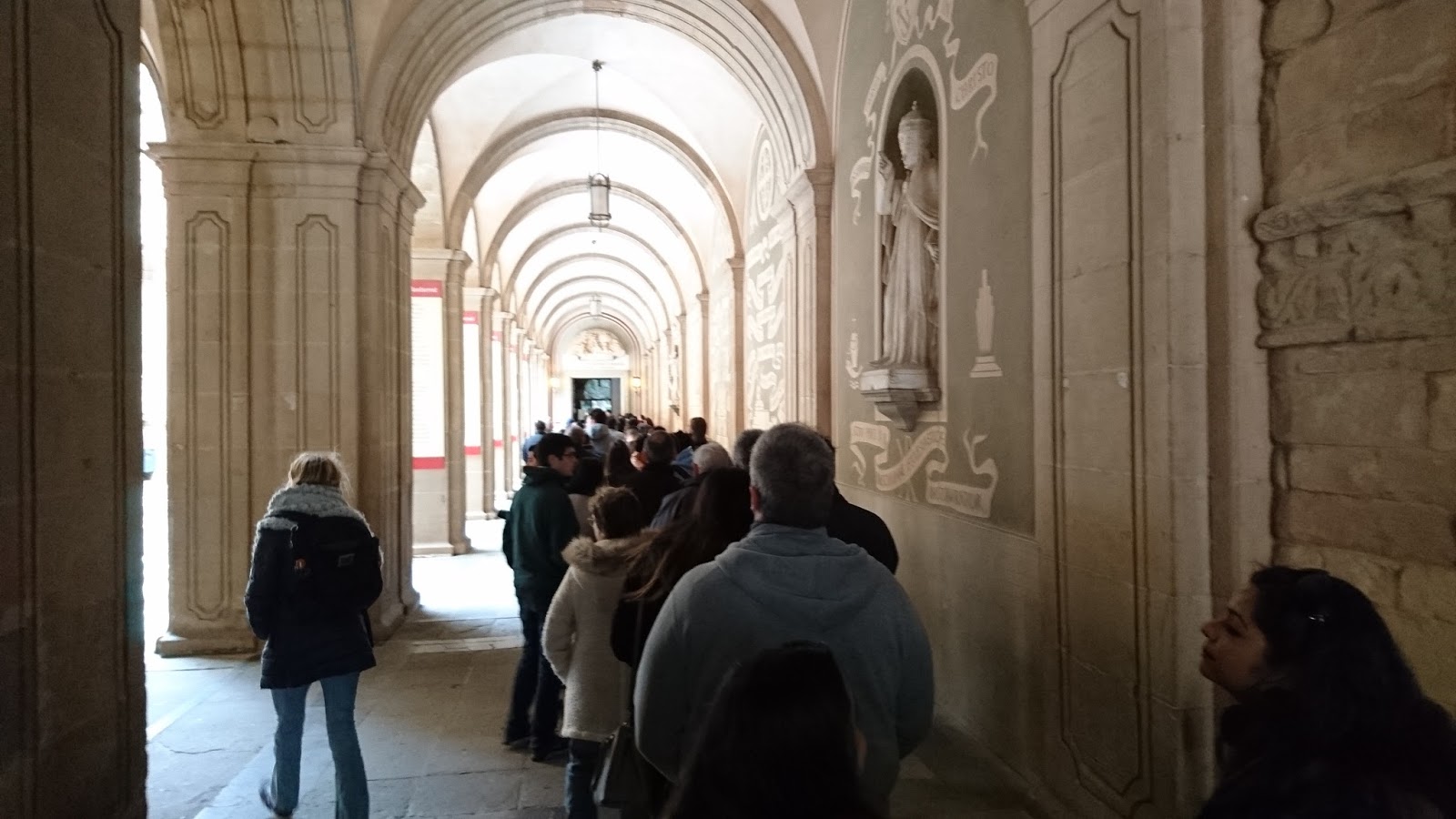
The thing to remember if you want to see the Black Madonna is that you have to be very patient. There is a bit of a queue, and as it is free entry, there is no jumping the queue by booking in advance. 

The thing to remember if you want to see the Black Madonna is that you have to be very patient. There is a bit of a queue, and as it is free entry, there is no jumping the queue by booking in advance.

The thing to remember if you want to see the Black Madonna is that you have to be very patient. There is a bit of a queue, and as it is free entry, there is no jumping the queue by booking in advance.

As I had other things to do back in the city, I did not get to see the Black Madonna, instead I was just content to look around the other parts of the Basilica.

As I had other things to do back in the city, I did not get to see the Black Madonna, instead I was just content to look around the other parts of the Basilica.


As I had other things to do back in the city, I did not get to see the Black Madonna, instead I was just content to look around the other parts of the Basilica.

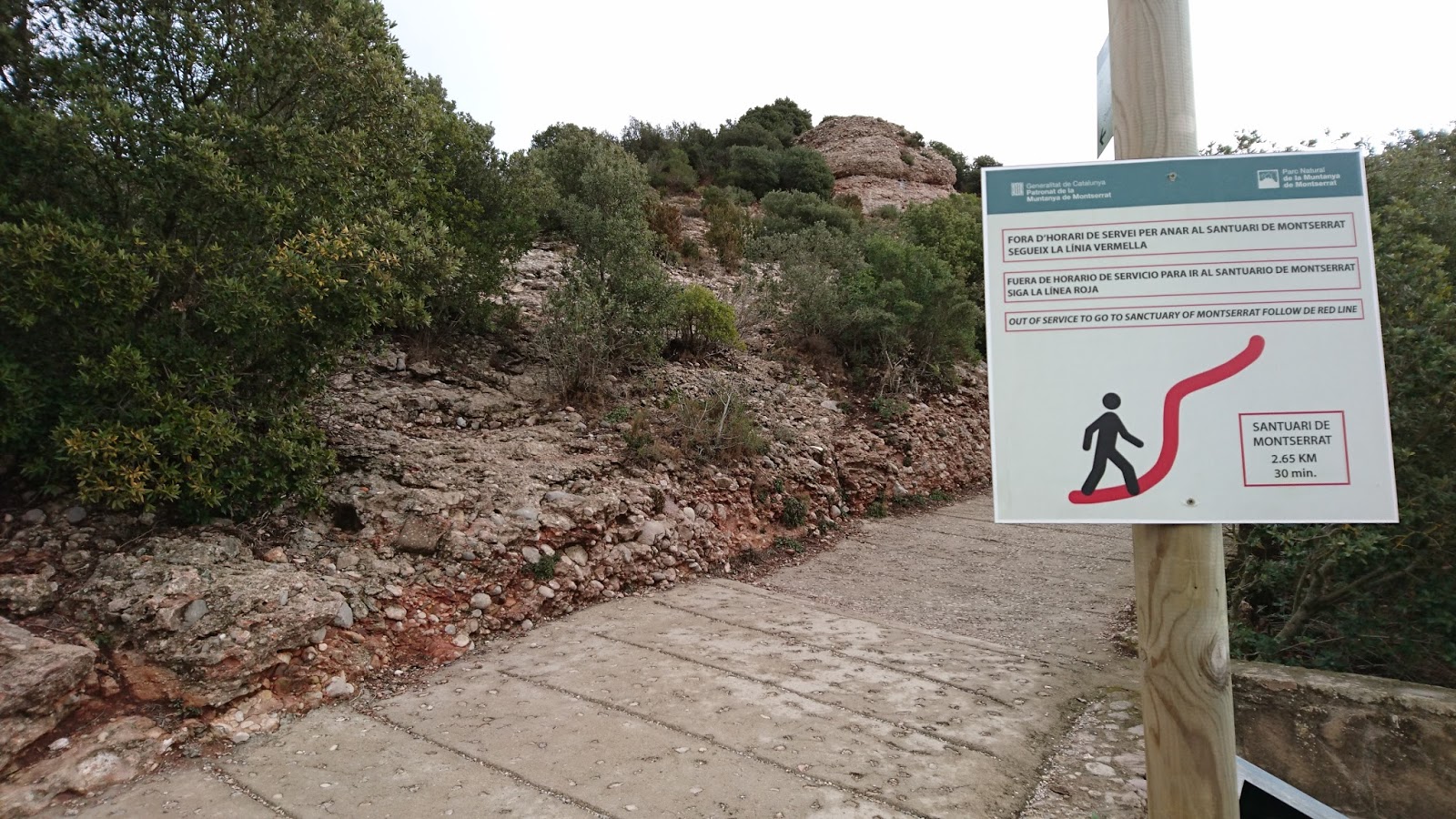
I got out of the Basilica and decided to go yet higher up this mountain as the Basilica is only located halfway up Montserrat.

How did I get to the summit of Montserrat I hear you ask?

Well, nothing quite that dramatic, I used the Furnicular, but only because I had already paid for it.

Well, nothing quite that dramatic, I used the Furnicular, but only because I had already paid for it.

Well, nothing quite that dramatic, I used the Furnicular, but only because I had already paid for it.

The engine room of the Furnicular.

The summit I reached since, as you can see, there are points of the mountain still higher behind me.

I don't even know what that means.

I wish now I had taken a video instead of those clouds as they got trapped by the peaks of Montserrat.

Yes, that is a perfect diagrammatic representation of my walk from here on.

How I briskly got up to the summit I was attacking here.

How I briskly got up to the summit I was attacking here.

The path up here at the summit.

Standing room only at the summit

The highest point I reached on Montserrat. If you remember my pictures from the ground, I am actually now behind the peaks visible from that vantage point.


Looking to the other side of the mountain. The Aeri de Montserrat Cable Car Station is directly behind me (I think!)

Mountain climbing is hungry work, besides...

...part of my mission is to taste some genuine national cuisines of each country I visit.