Showing posts with label AU. Show all posts

Saturday, 19 July 2014

The AFRICOM That Africa May Tolerate

"Fas est et ab hoste doceri" [You can learn from anyone, even your enemy] - Ovid, 43 BC - 17 AD.

United States Africa Command - A Combatant Command tasked with protecting US interests in Africa.
Disclaimer:

This blog entry reflects on the Capstone Exercise at the end of my MSc. Defence, Development & Diplomacy degree at Durham University. The entry requires a strong disclaimer because my constituency will find it repugnant that I should say anything positive about the United States Africa Command. To my Comrades in the Republic and I, AFRICOM is a neo-imperialist tool that is a neo-imperialist tool. This role play that sees me speak in its favour is just an end of academic year simulation exercise and does not mean I confer any legitimacy in so doing to AFRICOM. I would however draw my compatriots' attention to the fact that in military affairs, emotions should play no part, we can copy what works even from our enemies and discard what doesn't. Hence Ovid's remark that opened this blog entry.

Durham University, School of Government and International Affairs - SGIA.
by Kudakwashe Kanhutu

The structure of this paper is as follows; Part A is a pre-Capstone Exercise paper I wrote explaining what my role would entail in the simulation. Part B is a reflection on the dynamics of the simulation so as to show what I learnt from the exercise. 

Part A: Pre – Module Report.

Complex Emergency in Dadaab: AFRICOM Security Advisor’s Role

Introduction:

This paper explains the role an Africa Command Officer would play if placed inside a complex emergency setting such as that of the Dadaab Refugee Camp in Kenya. It emphasises respect for institutional goals as the chain of command in the US Military is well established. Ultimately, all the effort and input from an AFRICOM officer is premised on achieving US foreign policy goals which are eliminating security threats to the US through enhancing partner (Kenya and Somalia) capacity to control their territories. This paper will view the Dadaab situation as a microcosm for applying US recommendations for improving partner capacity, while also paying attention to extraneous forces.

Organisational Background:

United States Africa Command (AFRICOM) headquartered in Stuttgart, Germany came into being on 1 October 2008. “AFRICOM is one of six of the U.S. Defense Department's geographic combatant commands and is responsible to the Secretary of Defense for military relations with African nations, the African Union, and African regional security organizations” (United States Africa Command, 2013). The Command is therefore subservient to policy directives from the White House and exists to support those policies. The policies are articulated in the Presidential Policy Directive as (1) strengthen democratic institutions; (2) spur economic growth, trade and investment; (3) advance peace and security; and (4) promote opportunity and development (White House, 2012). The theme running through these directives is the understanding that there needs to be a holistic approach to achieving security for the partner countries. The concept applied towards realizing these goals is that of 3 – D (Defense, Development and Diplomacy) whereby “traditional military and police organizations continue to play major roles, but are closely coordinated with all the other instruments of power under the control of the civil authority” (Strategic Studies Institute, 2006). Unsurprisingly then our mission statement reads: “United States Africa Command, in concert with interagency and international partners, builds defense capabilities, responds to crisis, and deters and defeats transnational threats in order to advance U.S. national interests and promote regional security, stability, and prosperity” (United States Africa Command, 2013). Still, the Command is not without its critics.


Voices Against AFRICOM:


The fact that AFRICOM is headquartered on European soil and not in Africa is testimony to the opposition the Command faced in its inception as it was viewed by African States as an imperialist tool. There are accusations that AFRICOM is really about countering China’s rising influence on the continent; with The Guardian (2012) recording that, in an unguarded moment, a top AFRICOM official declared that the Command “was about preserving the free flow of natural resources from Africa to the global market." The further accusation is that the United States has adopted a strategy called “offshore balancing” whereby naval and air assets are used to support pliant local forces in protecting the United States’ interests (Axe, 2011). The same official, Vice Admiral Robert Moeller, quoted in the unguarded comment above has sought to clarify our position. The key points he raised are that AFRICOM does not create policy but executes its remit, which is; protecting American lives through working hand in hand with the diplomatic corps and listening to the concerns of its African partners (Moeller, 2010). The question has been asked as to why a military command is the United States’ chosen vehicle for engagement with Africa but a look at the security situation in most African countries necessitates this, security being a basic condition for achievement of development (RT, 2014). With this in mind we can now envisage the role an AFRICOM officer will play in Dadaab: supporting our partners in building and maintaining their capacities. 


Partners: African States


Both the Transitional Federal Government (TFG) in Somalia and the Kenya government face the security challenges posed by irregular militaries and violent extremists of Al Shabaab. These include terrorist attacks and kidnapping for ransom. In this regard there is a shared interest with AFRICOM’s remit of fighting Al Qaeda’s affiliates and protecting partner nationals from abduction. Here, under direction from the State Department (Ambassador to host state) and within the parameters of international law, the AFRICOM officer will provide the necessary assistance to the national security forces (Njubi, 2011). The unique capabilities that the United States brings are Intelligence, Surveillance, Target Acquisition, and Reconnaissance (ISTAR). The AFRICOM officer will work closely with the local security forces to advance peace and security as this is the primary purpose of the Command. Al Shabaab was specifically mentioned by General Carter Ham, who said it would count as AFRICOM “mission failure” if it were able to train people who will carry out attacks on American soil (AFRICOM, 2011). The important aspect for the AFRICOM officer in Dadaab is to study the dynamics of the camp and, drawing on knowledge of counter-terrorism doctrine, share his assessment of what ought to be done to restrict Al Shabaab’s ability to use the camp for rest and recuperation or any other activities that cause insecurity. In this remit there is also a need to be cautious about aiding and abetting human rights abuses by the host state as this would not sit well with our other partners.


Partners: United Nations, European States & NGOs


Having satisfied the respect for sovereignty requirement of being there by invitation of host state, there is a need for coordination and coherence between the many actors so that we do not work at cross-purposes. There is bound to be some institutional frictions as development and relief agencies such as the Red Cross may feel association with the military impinges on their neutrality principle. For this purpose, AFRICOM will follow the lead of the State Department and USAID in this simulation.


Conclusion: 


This brief paper has highlighted that the AFRICOM officer in the simulation will be guided by the United States Presidential Policy Directives in his engagement with the Dadaab Simulation exercise. There is also a need to respect the African partners’ wishes and to follow the lead of the State Department.

Video Essay:

To elicit what AFRICOM thinks it is about, I watched a former Commander speak on his task here:


For mannerisms in the role play, I trusted Hollywood:


Durham University - School of Government & International Affairs - MSc Defence, Development & Diplomacy; MSc Conflict Prevention & Peace-Building  Class(es) of 2014. 

Part B: Post Module Report

Capstone Exercise:  Complex Emergency in Dadaab, Post-Module Report.


Introduction:

This report reflects on my participation in the humanitarian emergency simulation that took place at Durham Global Security Institute (DGSi), Durham University from 21st May – 23rd May 2014. The paper is divided into two sections, with Section I focusing on how effectively I played my role. This section sets out my goals, my plans for achieving them and then what constraints and opportunities I encountered in that regard. It also answers the question how much was my role a hindrance or help in achieving the stated group’s aims of providing humanitarian relief in a fast developing crisis situation. 


Section II is a discussion of the relevant theories and concepts from my core modules throughout the year. In this section I choose what I think are the most significant concepts from my year-long study at DGSi which guided my efforts and goals in the Capstone exercise. The most important concept for me is 3D policy coherence, which states that for political goals to be achieved, equal attention should be paid to the imperatives of defence, development and diplomacy since neglecting one domain creates problems that feedback negatively in the other domains. My role in the simulation was that of Colonel Mike Carter, a United States Africa Command (AFRICOM) Officer on a fact-finding mission related to security threats in the region. I had the freedom to act when the need arose, but in strict accordance with AFRICOM’s goals as articulated by the President of the United States in the Presidential Policy Directive.

Section I 

Personal Reflection on the Simulation:

The setting for the simulation was the Dadaab refugee camp in North-Eastern Kenya, close to the Somalia border. This camp was established in 1991 due to the total collapse of the state in Somalia and the violence that ensured, and now houses around 470 000 people. With either renewed fighting in Somalia or cycles of famine, the camp continues to receive more refugees seeking shelter from these threats. Our simulation took place at a time when the camp was receiving a new influx of refugees from the latest crisis in Somalia. The task of the whole group was to coordinate our different capabilities and specialities so as to successfully deal with an unfolding humanitarian crisis over four days. As the Kenya government and Transitional Federal Government in Somalia (TFG) do not have the requisite resources to manage these crises, the international donor community is very active in these camps, with the United Nations High Commission for Refugees (UNHCR) being a very important player. I envisioned this as a microcosm where the donor agencies would fill in for government where its capacity has been so obviously stretched and so practice the aspects of good governance the donors tend to preach. 

For the organisation I was representing – AFRICOM – it was a chance to apply US recommendations for improving partner capacity in coordination with our other European and United Nations allies. The task set for AFRICOM by the President of the United States is that of supporting policies that attempt to advance both security and development in Africa as underdevelopment has, since 9/11, been seen to threaten the security of the United States. 

My own task, as Colonel Mike Carter of AFRICOM, was a fact finding mission related to the on-going instability in the region, with the activities of Al Shabaab being of the most serious concern as they are affiliated with Al Qaeda. The threats from Al Shabaab are kidnapping aid workers for ransom, using the camp as a staging post for revenge attacks against Kenyan government involvement in Somalia, attempting to recruit fighters among the population and hijacking of food and medicines meant for the camp’s population. My engagement was guided by the counter-insurgency idea that force has its utility but should be supported by other instruments of policy so as to win the battle for the hearts and minds of the population. As the United States is not actively at war in Kenya, my aims were to support any initiatives by the donor agencies that would help the population so as obviate Al Shabaab’s appeal as an alternative.

I was aware of the fact that there are frictions between the Department of Defense, which AFRICOM is a part of, and the State Department and USAID. These largely relate to the fact that the Department of Defense (DoD) is encroaching onto what is traditionally State Department/USAID territory and, also, the DoD tends to be given carte blanche where resources to carry out its missions are concerned. The other points of friction I anticipated were that organisations like the Red Cross who were players in this simulation would not want to be associated with AFRICOM because of their neutrality principle. To ensure that I would not be engaged in competition with my allies in the camp, I allowed the USAID local conflict advisor to take the lead as she was more in touch with the realities in the camp and also would be acceptable to actors who may be averse to dealing directly with the United States military. 

In terms of my goals of supporting any development initiatives that would undercut Al Shabaab’s appeal as an alternative I contributed D3 000 to the UNICEF education and WASH initiative, and D1 000 to the CARE emergency food and water fund when the food trucks were stuck in floods. The biggest project I contributed to was the Kenyan Government Police Training and Equipment supply programme. I contributed D16 000 towards this project. This project was proposed by the UK Conflict Advisor, but I had serious reservations about it because it proposed to change the salary structures of the police force by pledging to pay officers in Dadaab more than officers in the rest of the country. This, I felt, was assuming the task of the legislature where we had no right. Overall I was satisfied with my contribution as it adhered to the “Do No Harm” principle; all my contributions were for projects that aimed at human security not the undermining of it. 


Still, there were a lot of things that were outside our control. The hijacking of food trucks and subsequent distribution of food to the camp was an Al Shabaab tactic to win hearts and minds that we could not do anything about. The kidnapping of a high profile British UN representative was also out of our control and my only advice to UK Conflict Advisor was that use of force would not achieve her release and so instead he would have to negotiate with the captors. I also would have wanted to interact more with the security services but this was minimal since there was no military presence but just the police who were kept busy by their tasks throughout the simulation.

Section II

Theories and Concepts Guiding My Participation:

The first guiding principle comes from Rupert Smith’s conceptualization of what war is in the twenty first century: war amongst the people. He has conceived war amongst the people quite differently from traditional battlefield engagements in that “it is the reality in which the people in the streets and houses and fields – all the people, anywhere – are the battlefield. Military engagements can take place anywhere in the presence of civilians, against civilians, in defence of civilians. Civilians are the targets, objectives to be won, as much as an opposing force” (Smith, 2006: 4). There is therefore a fight to capture the hearts and minds of the people and usually this cannot be achieved by military means but instead by development and diplomacy tools. Smith (2006: 277) thought that the mistake politicians make is to think the military can create and maintain this condition through force, thus the other tools that are appropriate for it are chronically under-resourced.

In this conception he recognises the limits of force where military success can be achieved but yet the political goals are not attained (Smith, 2006: 5). He also outlines the structure that governs the conduct of Western militaries, with the political level being given primacy as the source of power and decision (Smith, 2006: 11). This winning of hearts and minds theme is what has guided the Pentagon’s engagement with Africa through the United States Africa Command (AFRICOM). This command was thus presented as one that is not a traditional military command but one willing to listen and respond to its African partners’ needs (Bachmann, 2010: 566). AFRICOM more than any other command, is premised on trying to achieve human security for target populations.

Thus, the outstanding theme that guided my participation was 3D policy coherence, which Weiss et. al. (2009: 9) defined as the need for “institutions that once largely acted autonomously – defense, diplomacy and development – to exchange information, share resources and cooperate in strategy development and implementation.” The military efforts should be complemented by development and diplomacy, with the most appropriate tool for the situation being given primacy. For the United States, the actors involved are the Department of Defence, United States Agency for International Development (USAID) and the Department of State. Among these actors there will be conflicting institutional strategic outlooks that then need to be made to cohere. The Department of Defense would ordinarily prioritise physical security to the detriment of developmental issues like providing education and health. It is widely pointed as a flaw of consecutive White House administrations that they prioritise the Department of Defense and pay little attention to development issues since USAID is but an adjunct in the State Department and not a standalone institution (Weiss et. al., 2009: 26, Bachman, 2010: 569). Further, there is a view that institutional competition among these organizations blocks the attempt at coherence (Weiss et. al., 2009: 26). 

The United States only prioritised the security threats that can come from weak and failing states after the attacks of 11th September 2001, with President George W. Bush declaring “that America was now more threatened by weak and failing states than we are by conquering ones” (Patrick, 2009: 57). 3D policy coherence was touted as the means to successfully counter this new threat domain but instead departmental mandates and concerns have stood in the way of this (Patrick, 2009: 60).

Coming to the specific branch of the Department of Defense I was representing – AFRICOM – the same themes of 3D policy coherence are instructive, and importantly I paid attention to the criticisms that have been levelled specifically at AFRICOM. The main criticism against AFRICOM is that it is about countering the rise of China and “preserving the free flow of natural resources from Africa to the global market" (The Guardian, 2012). This view is shared by most African states who have opposed AFRICOM being located on African soil, so instead it is located in Stuttgart, Germany. In this view, the priority for the United States is providing for its physical and energy security and not achieving human security for the local population. The argument is that if AFRICOM was really about supporting the goals of the local population’s aspirations for living secure lives, then development assistance would be prioritized and not military assistance. This criticism, while valid, also runs into an equally valid rebuttal that security is a basic precondition for development and a sober look at the security situation in most African states will yield that military engagement will be necessary where state capacity is largely absent (RT, 2014). 

The other important thing to remember about my role is that my ability to act was circumscribed by institutional constraints. The United States military does not decide policy, the White House decides policy and the military is just a tool that executes that policy. Although in my role as an AFRICOM Officer here, the gist of the White House’s Africa policy conformed to the concept of 3D coherence I have outlined above. The White House Presidential Policy Directive (2012) sets out the US policy goals as (1) strengthen democratic institutions; (2) spur economic growth, trade and investment; (3) advance peace and security; and (4) promote opportunity and development (White House, 2012). These goals if well-coordinated should result in human security being achieved for African partners as well as threats to the United States thus being reduced. 

However, the other side of the coin is that where the United States national interests diverge with African states' interests, the United States will act in its interest first. What has aroused US interest in Africa according to Bachmann (2010: 567) is the “sudden strategic relevance of Africa” with this five factors being salient; “HIV/AIDS, terror; oil; armed conflicts; and global trade.” In a globalised world where threats are no longer territorially bound, these factors are important for the whole globe as disease, migration, terrorism and armed conflicts have been shown to affect neighbouring as well as distant countries. The downside to the securitisation discourse is that it tends to disempower the people in developing countries as, for example, defining migration as a threat can result in racist and exclusionary outcomes (Ibrahim, 2005: 165). The securitization of ungoverned spaces may also mean that the United States may partner with governments involved in rights abuses if they can help the US achieve its security goals, to the detriment of the local population.

The possible remedial measure to this problem is the deepening, broadening, and emancipatory praxis proposed by critical security studies. While I, of course, could not follow this proposal in the opposite direction to the stated goals of the United States where it leads, I was aware of the importance of this concept in my role play. The critical security studies framework questions the dominant discourse so as to establish the true causes of state fragility, whose security is being pursued/ignored and what can be done to emancipate the local population so that their human security concerns are not ignored in their engagement with the developed world (Gunning 2013). I was conscious of these concerns in the role and acted according to them, where I could.

Conclusions:

This paper was a reflection on the author’s participation in the Capstone Complex Emergency in Dadaab at the end of the Durham Global Security Institute (DGSi) 2013/14 academic year. The exercise brings all participants in the MSc programmes here together to act out how the skills they have learnt may apply in a fast unfolding humanitarian crisis. For the 2013/14 Capstone Exercise I played the role of Colonel Mike Carter, a US AFRICOM Officer on a fact finding mission to the camp so as to better understand the nature of the challenges posed by Al Shabaab and the deficiencies of the partner African states – Somalia and Kenya – in countering these challenges. I managed to contribute positively to the human security agenda in the camp by providing money for education, food and security sector capacity building. The concept that guided my participation was 3D policy coherence; advancing development and security at the same time so as to achieve human security. 


Photo Essay: 

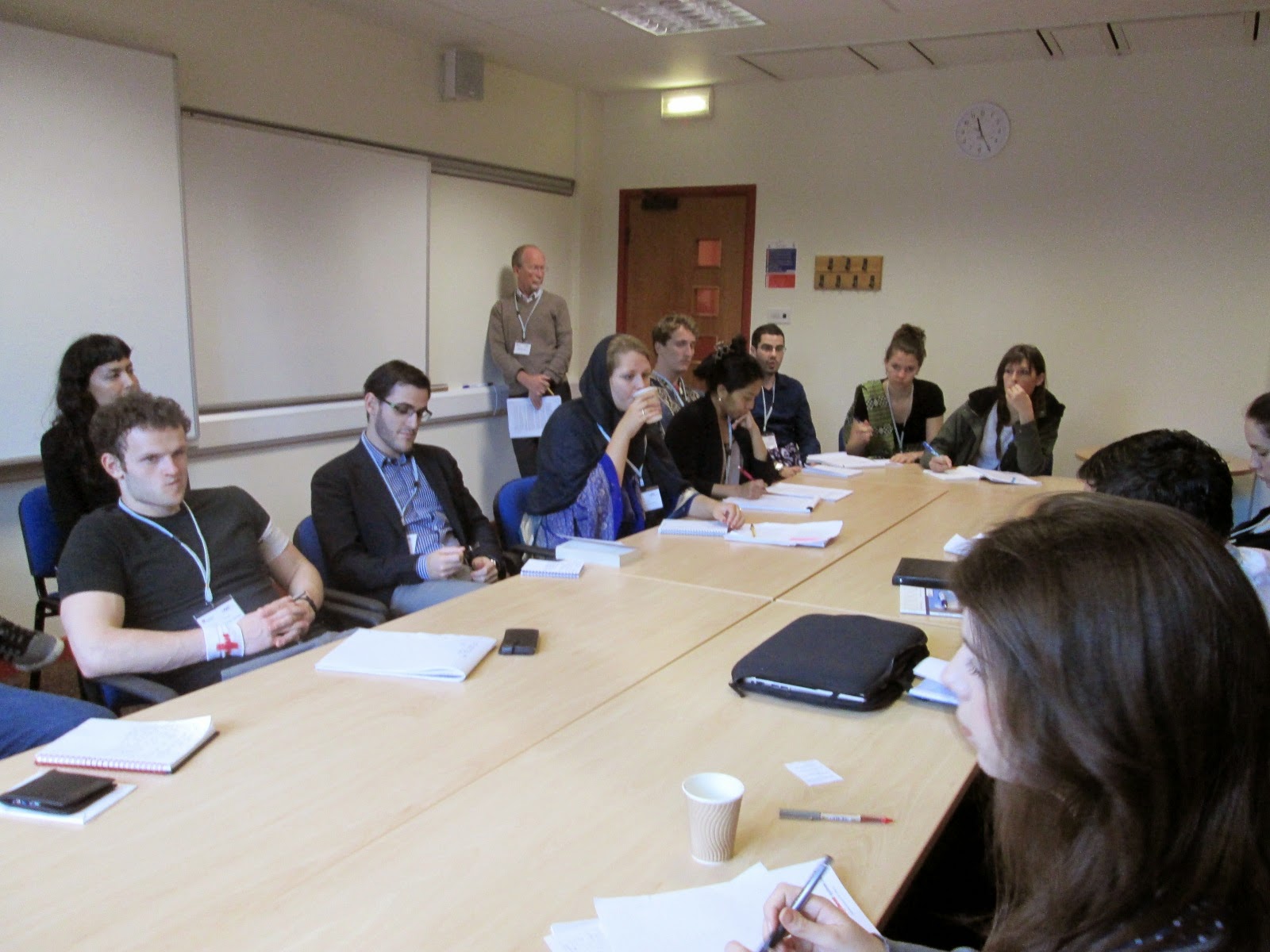
In no particular order, pictures from the 3 day simulation at Durham University from 21 - 23 May 2014.


Bibliography:


Axe, David (September 2011), America’s Somalia Experiment, The Diplomat. http://the-diplomat.com/2011/09/05/america%E2%80%99s-somalia-experiment/?all=true Accessed 15 May 2014.

Bachmann, Jan (2010), Kick Down the Door, Clean up the Mess, and Rebuild the House – The Africa Command and Transformation of the US Military. Geopolitics, Vol. 15 No. 3: 564 – 585.

Glazebrook, Dan (June 2012), The Imperial Agenda of the US's 'Africa Command' Marches On, The Guardian. http://www.theguardian.com/commentisfree/2012/jun/14/africom-imperial-agenda-marches-on Accessed 27 June 2014.

Gunning, Jeroen 2013, Introduction: Debates, Definitions, Power and Policy, Lecture delivered at Durham Global Security Institute, Durham University on 7 October 2013. Bottom of Form

Ibrahim, Maggie (2005), The Securitization of Migration: A Racial Discourse. International Migration, Vol. 43, No. 5: 163 – 187. 

Moeller, Robert (July 2010), The Truth About Africom: No, the U.S. military is not trying to take over Africa. Here's what we're actually doing.  Foreign Policy. http://www.foreignpolicy.com/articles/2010/07/21/the_truth_about_africom Accessed 15 May 2014.

Patrick, Stewart M. (2009), “The US Response to Precarious States: Tentative Progress and Remaining Obstacles to Coherence,” in Weiss, Stefani, Spanger, Hans-Joachim and van Meurs, Wim (eds.), Diplomacy, Development and Defense: A Paradigm for Policy Coherence. Gutersloh: Verlag Bertelsmann Stiftung: 54 – 104.

RT (2012), Crosstalk – AFRICOM, https://www.youtube.com/watch?v=mkinBtaZe5Q Accessed 15 May 2014.

Smith, Rupert (2006), The Utility of Force: The Art of War in the Modern World. London: Penguin Books.

Strategic Studies Institute (2006), Defense, Development and Diplomacy (3D): Canadian and U.S. Military Perspectives, Colloquium Brief, http://www.strategicstudiesinstitute.army.mil/pdffiles/pub732.pdf 15 May 2014

Wednesday, 17 October 2012

Fighting Fire With Fire

“In the midst of peace, war is looked on as an eventuality too distant to merit consideration” – Vegetius.

S - 400 All Altitude Missiles (Russian). Making the skies safe for locals. Picture by Open Source INTelligence.

by Kudakwashe Kanhutu 

[Balancing, since pleas to common sense are bound to fail...] 

The insights of the above Vegetius quote are not lost to the African National Congress Youth League. Thus, Julius Malema was right to opine that Botswana presents an insidious threat to stability in the SADC region if it allows foreign powers to have bases there. We all saw the stupidity of Laurent Gbagbo who tried to talk about sovereignty when French troops already had bases in Ivory Coast; the same troops who put Gbagbo in power then toppled him. The AU Charter should not allow member states to have foreign military bases on their territory,[1] but of course the AU Charter is a script for a stand-up comedy routine: Djibouti, Ivory Coast and Uganda, to name a few, already house AFRICOM structures of some sort. I also thought it unfortunate that President Zuma would come down on Julius Malema for saying “regime change,” a term that has never got anyone in trouble as it is a common term among leaders in the West, but I digress. If we agree that the AU Charter is: (1) a worthless rag and, (2) that the traditional notion of sovereignty anyway would conflict with any Charter article prohibiting inviting foreign forces – and thus allows any country to have military to military cooperation with any power to its heart’s content – then the way to counter threats posed by foreign forces in neighbouring countries is an imperfect but age old one. 

A First Sight of the Problem: 

When I was in Pretoria last year at a meeting with United States policymakers, one of the questions that was raised by them was how can the United States mend fences with the ANC? You see, the United States was the chief backer of South Africa’s apartheid system (much in the same way they back Israel today, common sense and world opinion be damned!). Hell, President Nelson Mandela was still listed as a terrorist in the United States as late as 28 June 2008. Yes – 28 June 2008. I opined four clear steps that could ameliorate the trust deficit that thus exists between the United States and African states. Among my steps was a plea for the U.S and her proxies to respect the AU/SADC position on African issues. Looking back, I now think that the U.S delegates’ question was a rhetorical question; my time would have been better spent had I chosen to speak to the many rocks that speck the South African landscape. Their further responses in the discussion betrayed what I have now come to immediately recognise as an entrenched attitude of listening politely then completely ignoring AU/SADC wishes. 

Well, if people show such disdain towards a magnanimous and forgiving people as the United States has done to SADC, some posture has to be taken. From the first day I understood the full history of colonialism and apartheid, I have always said it is the United States which should be begging to have a relationship with SADC and not the other way round. SADC did not wrong the US and her proxies; it was the U.S and her proxies that brought apartheid and colonialism to our shores and perpetuated it. Why then are the African states on all fours to be recognised by the former coloniser? It is a big question with many answers, such as; on the one hand you have idiocy and sycophancy in the same country (read Gbagbo and Quattara respectively), while on the other hand you have inexplicable stances such as that of Botswana under Ian Khama; name the man or woman who can explain Botswana’s counter productive agitation towards other SADC states. 

But the answer I think is significant as to why African states still court the former oppressor is that there is a sparseness of credible alternatives. To illustrate my point I will use Zimbabwe as my example from here on. We have all heard of Zimbabwe’s Look - East policy, much good has that done; China could not even inject the $10 bn that was needed to keep the Zimbabwean economy afloat in 2008. Also despite the exaggerated cries of a ‘yellow peril’ by the West, I too have misgivings about the conduct of Chinese investors towards Africans. Thus I argue a better variant. I argue that in China, we are courting the wrong giant, on the wrong field; for the next six years we should court President Putin’s Russia in all fields. China has its uses but it walks too softly. Russia on the other hand, has sharply pronounced an ambition to see the basic building blocks of international law preserved. It is Russia that has said that natural resources should remain an issue of national sovereignty where other greedy nations are planning an onslaught against this long standing principle of international law.[2] It is Russia which has been adamant that non intervention in a state’s domestic affairs should be upheld, otherwise all hell breaks loose. Russia too went through the catastrophic economic quandary, which the United States is so wary of; and survived without having to plunder foreign lands. Russia has never been a colonial power in Southern Africa or have they enslaved our people, or sponsored apartheid here in any form. Russia under President Putin is a good country to have relations with in all fields. Mind you, how else can we solve the Botswana problem? 

Every Problem Has A Solution: 

We all know from childhood the story where the hare challenged the elephant to a tug-of-war on the same day he challenged the hippopotamus. The hare’s plan was to pit these two giants against each other for his amusement, and he did. Without any culpability on our part, we find ourselves in a near similar situation today. The slight difference is that, it is the hippopotamus that has been challenging us (a minnow) to a tug-of-war for the past 12 years, while the elephant, gentle giant that he is, has been indifferent. I am not going to continue along the path of parables and fable-speak for long, for the point I am making is a practical point with real world consequences. Thus, let’s forthwith assign terms; Zimbabwe is the hare, The United States of America and its underlings, Britain, France and Germany represent the hippopotamus, while China or Russia (under President Putin) is our gentle giant; the elephant. We just may now have our window of opportunity to accept the hippopotamus’ long standing challenge to a tug-of-war, and like the hare in our fable; we must bring the elephant to this tug-of-war! 

The Problem Clearly Defined: 

President Putin comes to power at a crucial time, when the Western countries are mistakenly thinking that sufficient time has passed for the pain of colonialism to be now forgotten. Maybe, considering Zimbabwe got rid of the colonial yoke in 1980, they figure 32 years is long enough. Maybe they reckon since South Africa got rid of apartheid in 1994, sufficient time has passed. Maybe they are just desperate. I really don’t know how they calculated this, but I know they have decided that it is now time to repackage the colonialist project in the cloak of humanitarian intervention. President Mbeki quotes open discussions in Whitehall relating to renewed interest in accessing Africa’s resources by hook or crook.[3] In this new issue, Western countries actually stalk unrest in the country they will later intervene in for “humanitarian reasons.” Should the legitimate government of that country try to enforce order, this will be taken up by the Western media as the beginning of massacres and genocides that will require intervention by the “international community.” Intervention entails change of regime and the installing of a puppet regime that is friendly to the intervening countries. The puppet government’s end of the deal is to ensure access to resources and markets for the Western block in exchange for international legitimacy. How is this not colonialism? It is also quite a pathetic and transparent ploy, but does not a drowning man grasp at straws? 

President Putin reckons that the economic problems in the West today are forcing these countries to be wantonly aggressive in their search for a solution to their economic woes.[4] I believe him. Since I have already said that Russia has never been a colonial power in Southern Africa, President Putin has the moral ground to speak from. Unlike the United States which, may I remind you, had President Nelson Mandela listed as a terrorist as late as 28 June 2008.[5] 

Further Context: 

There is a palpable suspicion in academic circles that we have now entered the Third Cold War era. Relations between Russia and the West are frayed due to the United States and her proxies’ aggression in building a European Ballistic Missile Defence Shield. What this missile shield will do is take away the mutual vulnerability that has thus far ensured a stable ‘balance of terror’ between the U.S and Russia. This is the source of the major clashes between the two superpowers. Although the claim is that the shield is targeting rogue states, note that the shield will not distinguish whether missiles are from rogue states or from Russia. In any case is not a rogue state any state that the United States disagrees with at the time? The other obvious disagreements such as Russia’s position of largely respecting the building blocks of international law while the United States prefers what is expedient for the moment, are just symptoms not the disease. The bottom-line is that the United States is desperate to maintain its world hegemony against re-emerging and emerging new powers. Notice how the U.S refused to endorse the nuclear fuel exchange deal that Brazil and Turkey had brokered for Iran, not because the deal was flawed but because it had not been a U.S initiative. Observe also what has been called a policy of encircling China, military bases and diplomatic efforts placed to outmanoeuvre China on the whole globe. The hope for the U.S is to be able to dictate the law, not just to small countries but to Russia and China as well, once the United States and its proxies are invulnerable to long range missiles. President Putin has reacted to this disguised aggression by saying Russia should build a rival missile defence shield or build weapons that will ignore the missile defence shield. But I digress again, so I will not dwell much on the finer points of his solution, only to point out that he is conceiving the situation too narrowly. 

The Balance: 

In his article ostracising this disguised Western aggression; President Putin is blind to the fact that he is making the mistake of relying on the narrow solution of nuclear weapons as if Russia is still the basket case of the 90s. He is still holding on to the Russian position of being very inward looking, when a well-managed outward looking policy could win Russia useful and committed global allies without breaking her Central Bank. Russia should now start thinking in terms of exporting Russian culture, ideas, art and expertise to shore up her soft power. For instance, why should Zimbabwe recognise South Ossetia if not for the reason that her ally Russia thinks it is a legitimate thing to do? If not for the reason that Zimbabwe is obliged to stand shoulder to shoulder with her ally, Russia. 

Closely related to the above is this; the major reason why it took the West just under a month to attack Colonel Gaddafi and over 1 year to even contemplate attacking Syria despite the fact that both countries were on a similar trajectory, is because Russia has assets in Syria. These assets, should they have been damaged in a West led attack, would lead to a confrontation between Russia and the United States: game, set and match if the tennis phrase can ever be used aptly in the world of high politics. NATO furthermore cannot contemplate entering Syria because this is a contested airspace, Russian made air defence missiles induce much NATO apprehensiveness.[6] 

So, if Russia can be coaxed into looking beyond the Mediterranean, Zimbabwe is within her rights to invite military to military cooperation with Russia. Why should Zimbabwe suffer the consternation of being deprived of spares to such a backward fighter jet as the BAE Hawker Hunter when Zimbabwe could be flying Sukhoi - 35s? Why should Zimbabwe feel vulnerable to air attacks when her cities can be defended by an Air Defence Brigade wielding S – 300/400 missiles. The fact of the matter is that Russia is a leader in military technologies and many other fields, if she chooses to engage the world, countries wanting to preserve their sovereignty would do well to side with the Russia of President Putin’s vision. The West should not feel too aggrieved by this posture, the message to them would be a very friendly message; should they return to a scrupulous observation of the basic building blocks of international relations; should they return to a respect for sovereignty, honest partnerships and paying the going rate for resources, there is no reason why some limited cooperation cannot still be envisaged. 

Kudakwashe Kanhutu 
BA (Hons) Conflict, Peace & Security. University of Kent, Canterbury.
School of Politics and International Relations. 

MSc Defence, Development & Diplomacy. Durham University.
Durham Global Security Institute (DGSi). 

Prospective PhD Candidate. Graduate Institute, Geneva.
Thesis: “The State and Human Security in Zimbabwe.” 

 +447721474274 

Notes:

[1] Owing to the experiences with colonialism and apartheid, this should be a founding principle of the Charter.

[2] President Putin Being Strong: National Security Guarantees for Russia, http://rt.com/politics/official-word/strong-putin-military-russia-711/ (accessed 12/04/2012).


[3] President Mbeki Dullah Omar Eighth Memorial Lecture, http://www.unisa.ac.za/contents/colleges/docs/mbeki-speech%20at%20UWC%20(2).pdf (accessed 12/04/2012)

[4] President Putin Being Strong: National Security Guarantees for Russia, http://rt.com/politics/official-word/strong-putin-military-russia-711/ (accessed 12/04/2012).

[5] BBC, Mandela Taken Off U.S Terror List, 01 July 2008, http://news.bbc.co.uk/1/hi/7484517.stm (accessed 12/04/2012).

[6] CBS News, US General: Syrian Air Defence May Be Problem, http://www.cbsnews.com/8301-202_162-57391574/u.s-general-syrian-air-defense-may-be-problem/ (accessed 12/04/2012). Also see Senator John Mcain Interview on France 24, 12/04/12 where he says if the US cannot take out Syria’s Russian air defences then the taxpayers should question why the US government is taking their taxes.

Sunday, 14 October 2012

Soldier Without A Country

From Wikileaks we learn that Botswana ran to the United States in 2008/9 asking for military assistance, fearing Zimbabwe was about to launch a massive invasion. Knowing the Zimbabwe Defence Forces' mentality, had they chosen to attack Botswana, it would have been a surgical strike which, only God in high heaven, or the ZDF itself could prevent.

Zimbabwean Special Forces from 1 Commando Regiment.
by Kudakwashe Kanhutu 

“The soldier often regards the man of politics as unreliable, inconstant and greedy for the limelight. Bred on imperatives, the military temperament is astonished by the number of pretences in which the statesman has to indulge. The terrible simplicities of war contrast strongly to the devious methods demanded by the art of government. The impassioned twists and turns, the dominant concern with the effect to be produced, the appearance of weighing others in terms not of their merit but of their influence – all inevitable characteristics in the civilian whose authority rests upon the popular will – cannot but worry the professional soldier habituated as he is to a life of hard duties, self effacement, and respect for services rendered” - Charles de Gaulle 1890 -1970 

My name is Kudakwashe Kanhutu, Lieutenant Colonel Kudakwashe Kanhutu, Commanding Officer, 1 Commando Regiment; the foremost unit of the Special Forces in the Zimbabwe Defence Forces. My life has been duty bound from the very start, of pride in family possessions, placing others’ lives before my own and holding as inviolable the defence of our territory. Starting with the defending of the family livestock and maize plot from wild animals as a child, to protecting family members in playground fights at school. Destiny, it would seem, had pre-programmed my disposition. I do not know what the exact date is, but I am writing this from the cold hardness of a Botswana Military Prison cell, it is at least 10 years since my capture on 11 February 2009, but for the magnitude of the events I am about to recount to take root in your mind, let me start from the very beginning. 

I have never placed much emphasis on riches, in fact, I have what borders on disdain for worldly riches as they distract from the duty of service to the Nation. This is manifest, from the onset, in my decision not to take sole ownership of my parents’ property and livestock, as was my right as eldest son when my parents passed away while I was only 15. Choosing instead communal ownership where a greedy disposition would have assumed sole ownership and demanded that everyone else be subservient to that decision. There was no shortage of acts of bravery in my childhood. My family’s settling in the Zambezi Valley at the end of Liberation Struggle meant that we had to compete for living space with wildlife such as Lions, Leopards, Elephants and - the deadliest of them all - the Black Mamba. I have lost count of the number of times when I had to come to the aid, with other boys, of a homestead that had to fend off these predators. Many times these predators would attack people, but yet I find myself thinking, in retrospect, that none of these predators were as deadly as the politician, with his fickleness, his double dealings, conniving, scheming and deception. 

Soldiers are a breed apart, especially in my experience those of 1 Commando Regiment. Anyone who is willing to die for his country without question qualifies for that distinction. Politicians on the other hand concern themselves with ‘pulling strings’ when conscription is necessary, so that their sons and their friends’ sons do not end up serving in the military. For their own children, service in the military is to be avoided like the plague. It is ironic that people who depend that much on the military for their survival should hold it in such poor regard. 

My joining of the Zimbabwe Defence Forces was the most natural thing. After University I could have applied directly to the Zimbabwe Military Academy, to start life of service as an Officer but instead I went via the basic entry route; General Duty Infantry. The aspersion I held then was that in choosing to become an officer from the onset, I could never really be a soldier. I feared that the stratification of our society was also mirrored in the military by division between Officers and their men; where Officers would be living a life of privilege and enjoying trappings of wealth far removed from the asceticism that is a prerequisite for an honourable military life. I was pleasantly surprised to find this to be contrary to the truth. As soon as I had finished my basic infantry training I was transferred to the Zimbabwe Military Academy on merit, where I soon found out that my Officer training was doubly harder and more demanding than the one at Infantry School. The reasoning at ZMA was that as Officers we can only lead men into battle if we are at least equals with the best man in our units in all the physical requirements of our mission: we lead from the front. 

Excellence at training saw me transferred to 1 Commando Regiment. Subsequent combat operations saw my meteoric rise to Commanding Officer of the same unit, notably the last minute defence of Kinshasa from Ugandan and Rwandan troops; an operation executed with great precision but whose details I will neglect in this account for brevity’s sake. I will only defend our deployment to the Democratic Republic of Congo in its context as a humanitarian effort to give civilians of that country a moment of peace as civilians everywhere deserve. The DRC had continually never known peace with various foreign governments, including America, implicated in the instability. At the time of my DRC tour of duty, I was not yet privy to operational decision making, but I understood the necessity of the mission in the humanitarian context as opposed to the aspersions cast out by the media. 

My life, therefore, was a life dedicated to serving Zimbabwe to the exclusion of all else. In this sort of setting, where you are driven by the honour within you, the most common mistake is that you will think everyone in the Country to harbour the same feeling, which is a fatal mistake. You will essentially have no prejudices or suspect that some are driven by greed. 

The background to my head on collision with the politicians of Zimbabwe, the subject of this account, is indeed the economic quandary and political stalemate the Country was in. Politicians’ arguments, personality clashes and all else that played out needlessly. Each trying to out-do the other in showing who could damage the Country the most if he was not at the helm. Each flexing political muscles, the one ordering his supporters to slash and burn, and, the other - not to be outdone - running to the International Community and demanding they cut credit lines to Zimbabwe. The only one suffering being the ordinary man. In this vein, I find the best argument for rule by the military in developing infant democracies as opposed to the oversight of the military by civilians that is prevalent in the come-of-age democracies. The true military man gets his inspiration from the duty to protect the weak from exploitation, and, his strength is derived from the honour instilled in him by an inviolable military code. The true military man has no need for exploitative deception. 

Politicians on the other hand are ungrateful parasites, every four to five years they abandon their expensive suits, they dress down and descend on the ordinary people like vultures. They pretend to identify with the ordinary man’s plight, they lie, how they lie? They invoke fictitious backgrounds of trial by fire, and, because the ordinary man is not wise, this deception takes root and the tragedy is that it is repeated regularly and, still, ordinary people are none the wiser. All this is done to legitimate the group of politicians whose turn it is to plunder the Country’s resources. The anomaly of politicians having oversight over the military then ensures that the military is then obliged to be a blunt tool in the hands of politicians, subject to abuse. 

All the problems we were having in the Country, the economic meltdown, the political hate, the closure of hospitals and every other malady, were manifestations of dishonourable people having control over things they should not have control over. Of course because of the subservience to the Zimbabwe Constitution of the institution that was my station of contribution to the good of the nation, I found myself unable to initiate a course that I am now able to argue from solitary confinement in a Botswana Military Prison. How did this come about? 

Again the politicians came to us, with substantial proof that Botswana was training disaffected Zimbabweans to act as insurgents against the Zimbabwe government. This was not made up as some quarters argued at the time, sixteen men from my unit had actually joined these groups and so substantiated the existence of these acts of aggression. In a serious breach of protocol Botswana had also amassed troops on the border for manoeuvres. These manoeuvres had been observed by the Air Force of Zimbabwe’s reconnaissance planes. 

The Botswana Defence Forces had foolishly conducted these actions as a back-up to the foolish rhetoric their Commander-in-Chief and President was spouting at regional meetings. Whether he wanted to immortalise himself in the history books or driven by a heartfelt cause I do not know but, either way, he had chosen the wrong vehicle for these hands. Of course, when the politicians came to us they wanted the army to invade Botswana and attack the camps where the insurgents were being given training, reminiscent of their experiences with Rhodesian Armed Forces. Here, as so often happens, even to the most stringently opposed dictates, the military’s duty to maintain peace and stability coincided with the politicians’ need to preserve and perpetuate themselves. As the military our duty to maintain peace and order makes us very circumspect. It is necessary to have absolute peace in the Country, once that has been breached, we lose control and the outcome becomes very fluid, with never before known players surfacing with invariably ridiculous agendas to promote. 

The politicians were quoting their precious books of International Law and were desirous that we should set an example that will be remembered into eternity, or even occupy Botswana indefinitely. Such was their dexterity with empty words that, this was going to be “our War on Terror”. I, personally, do not like wars of conquest because they stretch the military and are unwinnable as the United States’ campaigns in Vietnam, Iraq and Afghanistan holds testimony. Furthermore, you have to take on duties of civil government like policing, a mammoth task among hostile foreigners. Personally I prefer defensive wars. I was also averse, in discussions with HQ, to attacks on fellow Zimbabweans without warning and reasoned that the guilty party was the most powerful man in Botswana. It was he who should come to answer questions on behalf of the Zimbabweans he had made criminals out of by providing military training to. After all, it was he who was most vocal and, he who was displaying all that great bravado. My dearest wish is that people who endanger lives while hiding behind political office should be made to answer questions on their actions away from their great offices. It is a simple psychological exercise. 

We also absolutely had to make a response because non action was dangerous in that it would embolden our detractor and award him allies who otherwise were not convinced. So to avert the danger of Botswana galvanizing countries on our borders into a coalition which would potentially set the whole Southern Africa region on fire, we needed something unheard of in war; the one single and instantaneous blow that would win the war. From our standpoint, the military manoeuvres on our border by the Botswana Defence Forces was an act of aggression. 

Thus I found myself accompanied by the Service Chiefs, outlining to the politicians, the alterations I had made to their instruction and detailing the form the mission would now take. I emphasized that the goal would still be the same but practicalities demanded that we follow a surprise commando raid with one objective; a solitary blow. There were great arguments from the politicians who sensed that there would not be great big flashes, jets screaming overhead and, death and destruction to captivate the world media and award them their interviews with CNN. I have to emphasize, away from post factor rationalisations, Botswana indeed posed a threat to the region through their undiplomatic and irresponsible action. Having established this, the mission was an absolute necessity. 

Zimbabwe Defence Forces Helicopters flying over a Southern African city.
The mission would in essence be carried out by 200 men from 1 Commando Regiment with me in the lead, 216 including the 16 who had already been in Botswana in the insurgents training camps, conducting various intelligence works. If that number seems low, that is because if the mission was executed with great secrecy, we would encounter negligible numbers to oppose us. Also, in terms of capabilities, the Botswana Defence Forces are essentially a bow and arrow army, in their whole existence they are not that much better than their civilians because they have never seen active combat anywhere. Conversely I was taking in veterans of the Mozambican, Somali and DRC wars. Support would ensure from the 7th Squadron of the Air Force of Zimbabwe. All military bases in the South West of the Country would be on high combat alert for a defensive war should the Botswana Army choose to cross into Zimbabwe. We would draw Botswana into an invasion, something they would never do especially with their Commander-in-Chief awaiting trial at Chikurubi Maximum Security Prison. 

Yes, at 2300hrs on February 10 2009, I was the greatest servant of the Zimbabwean Nation, poised to send a message to our neighbours that interference of a military nature in our domestic affairs would have their heads of state punished in a Zimbabwean Court of Law. On February 10 2009, at 2300hrs, I was standing by to rewrite the statute books of international relations. My men were standing by to bring Botswana to a standstill, telecommunications, the airport, Radio and TV stations were within fifteen minutes of my men’s control. Five 1 Commando Regiment Helicopters were standing by just fifteen minutes from Gaborone, to airlift ourselves and "Cargo One" back to Harare, having evaded Botswana radar earlier. The rest of the team would exfiltrate back to Plumtree on commandeered vehicles. 

At 2330hrs on the same day, the politicians in my country who had been at each other’s throat all along finally signed on to a Government of National Unity, of course the actual ceremony was done in the day time the following day for the sake of posterity. On reflection this was an agreement to share in the plunder of the Country’s resources. All the same, part of the agreement was to put all the cards on the table, and the 1 Commando Operation so necessary to the stability of the Country was one of the cards to be put on the table. Such that by 0001hrs on 11 February 2009, I was a criminal and adventurer, disowned by the politicians in my Country. A military operation that could have only worked because it was shrouded in secrecy, a precise mission to get into Botswana and arrest the Head of State without great bloodshed was thus compromised. Against the 5000 or so men the Botswana Defence Forces could master when warned in advance my men stood no chance. The numbers advantage was too overwhelming, unsuspecting of our presence we could have been superior to the Botswana Army units we would come across in the execution of the mission. Every single detail of the mission was relayed to Botswana by our great politicians and the Botswana Defence Forces have never had a greater day in their whole existence. I ordered that the men who were manning the outer ring of the operational zone exfiltrate back to Zimbabwe. Still, this left 60 Commandos in the inner ring which comprised the units that were to take charge of the telecommunications and the actual arrest of the Head of State. 60 soldiers sacrificed because the politicians had decided it is better to share the loot, after all... 

I used to be Zimbabwean, all those years ago when my heart used to beat with pride at the sight of a Zimbabwean flag fluttering in the wind. All those years ago when I used to stand to attention when the National Anthem was playing, when I would become agitated if I saw anyone, man or child, spell Zimbabwe without a capital Z. I used to be the most Zimbabwean of all Zimbabweans, all those years ago when I could spend hours doing nothing but think of ways to defend the nation from all enemies, foreign or domestic. I used to have a Country, but what happens when the fickleness of politicians overrides the sense of duty inculcated in a soldier’s fabric?